What Does Writing About Reading Look Loke
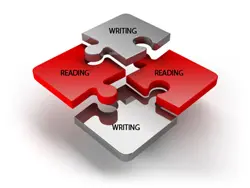
For many years reading and writing were (and sometimes still are) taught separately. Though the two have about e'er been taught by the aforementioned person (the English/Language Arts teacher) during the Linguistic communication Arts period or cake, educators rarely fabricated explicit connections between the ii for their students. Over the terminal ten years research has shown that reading and writing are more interdependent than we idea. The relationship between reading and writing is a fleck like that of the craven and egg. Which came first is not as important equally the fact that without ane the other cannot be. A child's literacy development is dependent on this interconnection between reading and writing.
The Relationship Between Reading and Writing
Basically put: reading affects writing and writing affects reading. According to recommendations from the major English/Language Arts professional organizations, reading educational activity is most constructive when intertwined with writing instruction and vice versa. Research has found that when children read extensively they become ameliorate writers. Reading a variety of genres helps children learn text structures and language that they can then transfer to their ain writing. In addition, reading provides young people with prior cognition that they can use in their stories. One of the principal reasons that nosotros read is to learn. Specially while nosotros are even so in school, a major portion of what nosotros know comes from the texts we read. Since writing is the human action of transmitting cognition in print, nosotros must have information to share before we tin write it. Therefore reading plays a major role in writing.
At the same time practice in writing helps children build their reading skills. This is especially true for younger children who are working to develop phonemic awareness and phonics skills. Phonemic awareness (the understanding that words are developed from audio "chunks") develops as children read and write new words. Similarly, phonics skills or the ability to link sounds together to construct words are reinforced when children read and write the aforementioned words. For older children practice in the procedure of writing their own texts helps them clarify the pieces that they read. They can apply their knowledge about the means that they chose to utilize detail language, text structure or content to amend sympathize a professional person author's construction of his or her texts.
Harnessing the Reading-Writing Relationship to Help Children Learn
Merely knowing that reading and writing are intimately connected processes isn't enough. In gild to help children develop these two essential skills, parents and teachers need to apply this cognition when working with them. Hither are a few strategies for using reading and writing to reinforce development of literacy skills.
Genre Study
One of the nearly effective ways to utilize the relationship betwixt reading and writing to foster literacy development is by immersing children in a specific genre. Parents and teachers should place a genre that is essential to a grade level'due south curriculum or is of item interest to a kid or group of children. They should then report this genre with the child(ren) from the reading and writing perspectives. Children should read and discuss with adults high quality examples of works written in the genre focusing on its structure and language as well as other basic reading skills including phonics and comprehension. Once children take studied the genre to identify its essential elements, they should be given opportunities to write in the genre. As they are writing, adults should assistance them apply what they take learned from reading genre specific texts to guide their composition. This process should be recursive to allow children to repeatedly move betwixt reading and writing in the genre. In the finish children volition non only take a solid and rich knowledge of the genre, but will also have strengthened their general reading and writing skills.
Reading to Develop Specific Writing Skills
Parents and teachers practice not have to engage in an extensive genre written report to foster their children's reading and writing abilities. Texts tin be used on limited footing to help children learn and strengthen specific writing skills. Parents and teachers should starting time identify writing skills that a particular child or group of children need support in developing. For example, many students in a 7th course form might have difficulty writing attention getting introductions in their essays. One of the most effective means to help children build specific writing skills is to show and hash out with them models that successfully demonstrate the skill. Adults should select a number of texts where the authors "blast" the area that they want to assist their children grow in. For our sample 7th graders we'd want to discover several pieces of writing with stiff, engaging introductions and read and analyze these with the students. Once children have explored effective models of the skill, they should exist given opportunities to practice it. They tin can either write new pieces or revise previous pieces of writing emulating the authors' techniques.
Integrating "Sound" Instruction in Reading and Writing
Phonemic awareness and phonics are two of the pillars of reading. Without agreement the connection between sounds and letters, a person cannot read. The connection between reading and writing can aid solidify these skills in immature readers. Parents and teachers should help children "sound out" words in both their reading and writing. When a child comes to a word in their reading that is unfamiliar, the adult(southward) working with her can model or guide her in sounding out the discussion using knowledge of phonemes (sound "chunks"). Similarly, if a kid wants to write a new word the adult(s) can use the same technique to help her choose which letters to write. If the child is younger, accurate spelling is non as important as an understanding of the connexion between detail sounds and messages. Therefore helping the child pick letters that judge the spelling is more appropriate than providing him with the actual spelling. If the child is older and has an understanding of some of the unique variations in the English language (such as silent "e"), the parent or teacher should encourage him to employ that knowledge to come with the spelling of the discussion.
Option in Reading and Writing
Another effective method for using the relationship between reading and writing to foster literacy evolution is simply giving children the choice in their reading and writing experiences. We larn best when nosotros are motivated. If children are always told exactly what to read and what to write, they will eventually either come to run across reading and writing as impersonal events or will "close down". Frequently in classrooms, teachers allow children to select their own books to read during contained reading time, but they rarely give them the opportunity to option their own writing topics. In lodge to encourage ownership over their reading and writing, children should be given chances to read and write what is interesting and important to them.
Talk Most It!
While it may seem like common sense to adults that reading and writing have a lot to do with each other, the connectedness is not always as apparent to young people. Parents and teachers should explain how the two skills reinforce and strengthen each other. Young people (particularly adolescents) often ask their parents and teachers, "Why do I have to learn this?" Here is a perfect opportunity to evidence the relationship between 2 essential academic and life skills.
Source: https://www.k12reader.com/the-relationship-between-reading-and-writing/
0 Response to "What Does Writing About Reading Look Loke"
ارسال یک نظر