What to Do With Baby Fawn Found in Backyard
What To Do If Y'all Find A Fawn
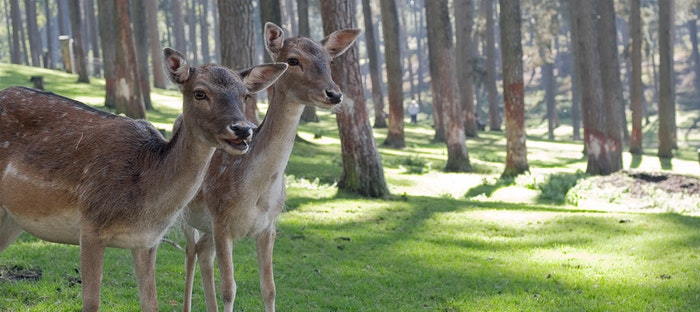
People sometimes detect a healthy newborn fawn in their yard. If they don't see the mother, they might think the baby has been abandoned and needs assist. This is ordinarily not the case.
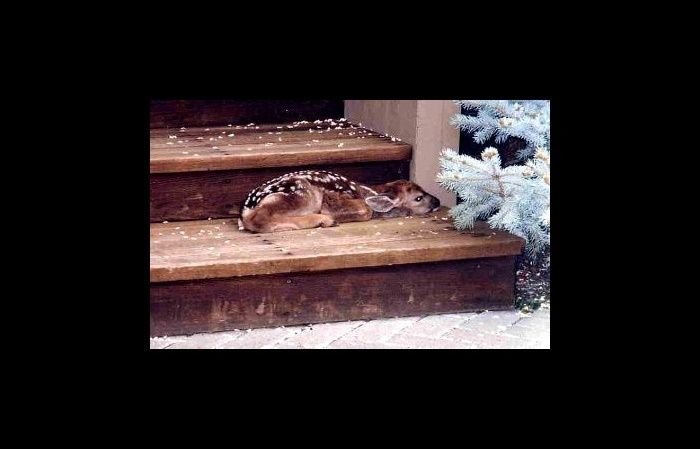
Fawns are ordinarily built-in sometime between late April and early July. Does nascency ane, 2 or occasionally three fawns. Finding i alone presents a situation when what non to do is equally important as what to do. If y'all find a fawn, don't move it. A mother doe will put her infant in a place she thinks is condom, usually in tall grass, near a tree or bush, or sometimes near a house. What seems rubber and hidden to her at sunset or dawn may not be condom once humans, pets, and cars kickoff moving well-nigh. She volition nurse her babe, stimulate it to eliminate and clean that up so there is no scent. The doe volition then leave the babe solitary because she knows her fawn does not have any smell for the offset few weeks of its life. However, she does. If she stays with her baby, her olfactory property will attract predators. Then she leaves it alone for hours at a time. She may return in the middle of the day, simply most often returns at dawn and dusk and will commonly move the fawn to a new location.

The baby's potent natural instincts tell information technology to stay where it is until the mother returns. It may motion around a few anxiety every bit its legs go stronger, simply will mainly stay subconscious near where the mother left information technology. If something approaches, a healthy fawn may flatten itself to the footing and freeze in an try to blend in.
If the fawn is lying quietly and is not crying more than a few calls, there is a very adept chance its female parent has been back and fed it recently and volition return again. Information technology is not truthful that brute mothers volition abandon babies that take been touched by humans. Animal mothers want their babies even if a human being has touched them. More often than not, mother doe volition come up back for her baby. But she may be too frightened to come up back until the area is articulate of all act.
 (deer browsing sunchoke foliage in my yard, so drank all the water in the bird baths)
Do non motion the fawn. People should move far away from the babe and all dogs should be moved inside and contained to give the mother a chance to return. If yous take moved the babe, put it dorsum where y'all found information technology, facing information technology abroad from you. Quickly run away before information technology follows. If it tries to follow, repeat. Even if it moves, it will want to stay near the cover of the forest and somewhen settle down. If it's hungry, its call will bring female parent doe. This may have hours. She may wait until dusk or dawn or she may return in the middle of the mean solar day, but she will render once the expanse is void of activity. A few hours after the next dawn or dusk you can return but close enough to check if the baby is gone. Usually it will be. Call up that no one can intendance for and teach survival skills better than a wild animal's own mother.
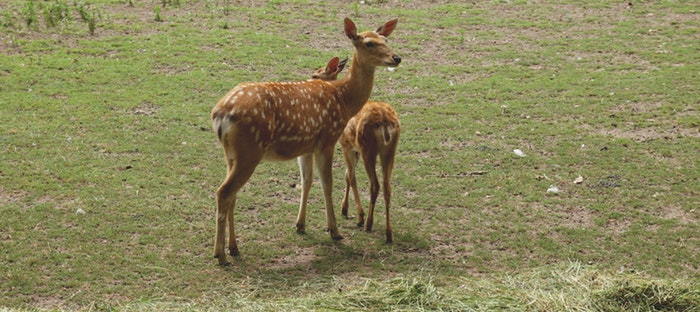
Still, if a the fawn is bleeding or manifestly injured, covered in flies or maggots, running around frantically, crying nonstop, running later on you, lying stretched out on its side, side by side to its dead female parent, has been left well past the side by side dawn or dusk, is in danger from cars or roads, or is stuck in a fence, contact Animal Control. Exercise not feed the fawn moo-cow'due south milk, babe formula, puppy formula, goat's milk or whatsoever other milk or formula. These tin can cause severe diarrhea and impale a fawn. A small amount of Pedialyte, Gatorade, or Smart Water at room temperature in a baby bottle volition help hydrate a fawn temporarily. Put the injured fawn in a covered domestic dog crate or solitary in a small room away from people, pets, and noises. To minimize stress, make sure information technology's in a warm area that is as quiet and dark as possible.

Do non try to keep the animal. Wild animals require dissimilar care than domestic pets do. Fawns have fragile digestive systems. Even a caring person can feed the incorrect food and cause more harm than proficient. A human being cannot teach a fawn natural survival skills such as how to retain its natural fears which are necessary to survive in the wild.
Like humans, baby wild fauna spend every waking moment learning from their own kind how to survive. They learn what they're supposed to practice, who they belong with, what to eat, where it'due south safe to play, live, sleep, hide, eat, how to get along with others of their kind, and the rules of being a fellow member of a herd. They too acquire when to stand up their ground and when running away can salvage their lives. Wildlife that grow up with humans cannot larn these survival skills. They abound upwardly believing they belong with humans. They cannot conform to life and survival in the wild. When they become adults, grow difficult to maintain, and with no skills for surviving in the wild, if released they become piece of cake prey for the start predator that comes along. If kept captive, they tin go dangerous.
 (White-tailed deer with chronic wasting disease)
Note of caution: Chronic wasting disease (CWD) is a contagious transmissible spongiform encephalopathy (TSE) of mule deer, white-tailed deer, elk, moose, and reindeer. As of 2016, CWD had been found in members of the deer family only. It causes a spongy degeneration of the brains of infected animals resulting in emaciation, abnormal beliefs, loss of bodily functions and death.
Always make choices that are best for the orphaned or injured fawn and for any other wild animal. Contact animal command as soon as possible so the deer can be properly cared for and somewhen returned to the wild with all the skills it needs to survive.
(Sources: (https://www.wildwatch.org/firstaid/feeddeer.htm; http://cwd-info.org/faq/; http://www.fawnrescue.org/fawncare.html; https://blog.nwf.org/2015/04/finding-a-fawn-what-to-do/)
Source: https://davesgarden.com/guides/articles/what-to-do-if-you-find-a-fawn
0 Response to "What to Do With Baby Fawn Found in Backyard"
ارسال یک نظر